QS vs THE Rankings: What's the Difference and Which Should You Trust?
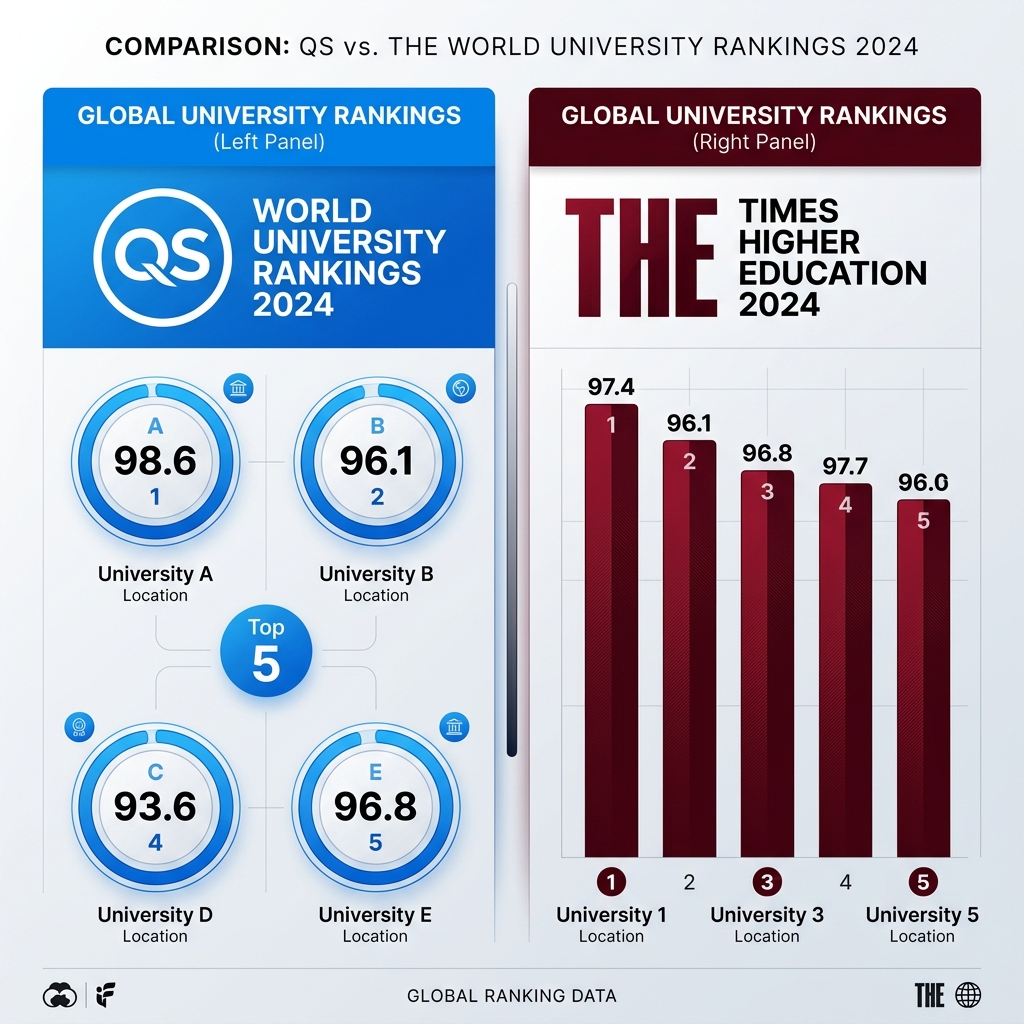
If you've spent more than five minutes researching universities, you've probably noticed something that looks like a contradiction. The same university can sit at #15 on one major ranking and #40 on another. MIT and Oxford trade places depending on which list you're looking at. Cambridge outperforms Harvard in one system and the opposite in another.
This isn't a glitch. It's a feature — if you know how to read it.
QS (Quacquarelli Symonds) and THE (Times Higher Education) are the two most widely cited university ranking systems in the world. Both claim to measure "university quality," but they define quality in meaningfully different ways. Understanding those differences is what separates a well-informed application decision from one that's based on noise.
What QS Actually Measures
QS weights academic reputation very heavily — it accounts for 30% of the total score. This comes from a global survey sent to academics, asking them which universities they consider the best in their field. The results are heavily influenced by name recognition and historical prestige. A university that has been famous for 200 years tends to do well here even if its recent research output has plateaued.
The other major factor in QS is employer reputation (15%), which comes from surveying hiring managers about which universities they prefer to recruit from. This makes QS particularly useful if your goal is employment after graduation — it's telling you something real about how the labor market perceives different institutions.
QS also gives significant weight to citations per faculty (20%), which measures research impact, and faculty-to-student ratio (20%), which is a proxy for teaching resources. The remaining 15% covers international faculty and international students — essentially measuring how globally diverse the campus is.
What THE Does Differently
THE uses a broader set of indicators and places more emphasis on research output and income. Teaching environment accounts for 29.5% of the score, but it's calculated differently from QS — THE relies more on student-to-staff ratios, doctorate-to-bachelor's ratios, and institutional income per student. It's trying to capture the academic intensity of the environment.
Where THE really diverges is in its research metrics. Research volume, income, and reputation combined make up 29% of the score, and citations (measured as research influence) add another 30%. That's nearly 60% of the total score tied directly to research activity. If a university is producing a lot of cited research, THE will rank it highly even if it's relatively unknown outside its field.
This is why you'll sometimes see smaller, specialized research institutions ranked much higher on THE than on QS. A technical university in Germany or a medical school in Sweden might not have the global brand recognition to score well on QS's reputation surveys, but its researchers are publishing work that gets cited constantly — and THE rewards that.
The Practical Difference
Here's a useful way to think about it: QS is weighted toward reputation and employability, while THE is weighted toward research intensity.
If you're going for a taught master's degree and plan to work in industry afterwards, QS rankings might be more relevant — they're capturing what employers actually think. If you're considering a PhD or an academic career, THE rankings give you a better picture of where the real research is happening.
For undergraduate decisions, both are imperfect proxies. Neither directly measures teaching quality or the student experience in any meaningful way. A university that ranks #5 globally might still have overcrowded seminars and overworked tutors, while a #80-ranked institution might offer genuinely transformative undergraduate education.
Where They Agree — and Where They Don't
At the very top, QS and THE largely agree. MIT, Oxford, Cambridge, Harvard, Stanford — these names appear near the top of both lists every year. The disagreements become more interesting as you move further down the rankings.
Asian universities, particularly from China, South Korea, and Singapore, tend to rank higher on QS than on THE. This is partly because QS places more weight on international connectivity and employer surveys, areas where Asian institutions have invested heavily. Chinese universities have also become highly effective at accumulating citations in certain scientific fields, which helps on THE too, but the overall pattern holds.
European research universities — particularly in the Netherlands, Sweden, and Germany — often outperform their QS rankings on THE. These institutions have strong research output but lower global name recognition, which drags down their QS scores.
So Which Should You Trust?
Both. Neither exclusively.
Rankings are tools, not verdicts. The most useful thing you can do is look at a university's position across multiple systems and ask why they differ. A university that ranks much higher on QS than THE is probably strong on reputation and employer relationships but less dominant in research. The reverse suggests a research powerhouse that's still building its global profile.
If a university ranks consistently well across QS, THE, ARWU, and US News — that's a signal worth taking seriously. Consistent performance across different methodologies means the institution is strong across multiple dimensions, not just gaming one particular formula.
You can compare rankings across all four major systems for any university on UniRankHub's comparison tool, or look up how a specific university has performed year-over-year on each ranking on their detail pages. Seeing the trends over time often tells you more than any single year's snapshot.
The rankings will never tell you whether a particular campus will feel like home, whether the professors in your department are accessible, or whether the city it's in suits how you want to live. Those things matter too. Use the data as a starting point, not a finishing line.